






book
gym
tour
- Meet with a coach
- Explore gym space & options
- Discuss goals and ambitions
- Develop a training strategy
- Discover the benefits of E4L

Healthy habit formation is a journey that can transform your life, one small step at a time. It’s not about drastic changes or quick fixes, but rather about building sustainable routines that stick. Whether you’re looking to eat better, exercise more, or kick a bad habit, understanding the science behind habit formation can set you up for long-term success.
Many of us have tried to form new habits, only to find ourselves falling back into old patterns weeks or months later. It’s easy to feel discouraged, but here’s the good news: forming healthy habits is a skill you can learn and improve upon. With the right strategies and a bit of patience, you can rewire your brain to make positive behaviours feel as natural as brushing your teeth.
Let’s dive into the fascinating world of good habits formation and explore how you can harness its power to create lasting positive change in your life. From understanding the habit loop to leveraging the power of your environment, we’ll cover evidence-based techniques that can help you build the healthy habits you’ve always wanted.
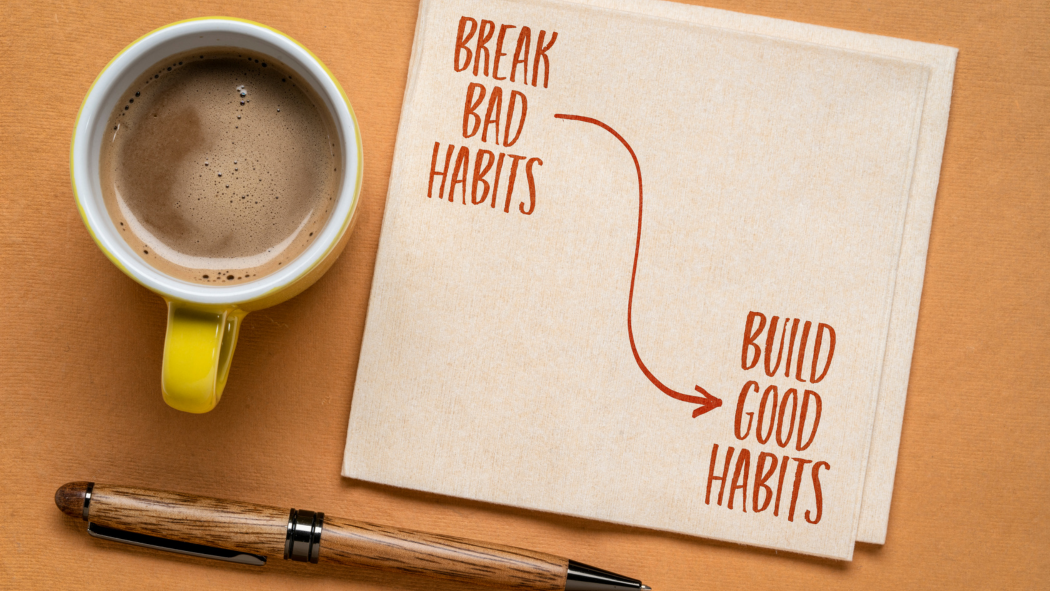
Lets break bad habits, form habits that last, improve mental health and sky rocket physical activity. Breaking bad habits drives behaviour change that lasts.

To truly grasp how we can form lasting healthy habits, it’s crucial to understand the science behind habit formation. At its core, a habit is a behaviour that has become automatic through repetition. But how long does it actually take to form a new habit? Contrary to popular belief, the oft-cited “21 days to form a habit” rule is more myth than fact. This idea apparently originated from the 1960 self-help book “Psycho-Cybernetics”, where plastic surgeon Maxwell Maltz observed that it took his patients about 21 days to get used to their new appearance after surgery. In reality, habit formation is far more complex and variable.
A groundbreaking study published in the European Journal of Social Psychology found that it can take anywhere from 18 to 254 days for a new behaviour to become automatic. On average, it took participants about 66 days to form a new habit. This wide range highlights an important point: the time it takes to form a habit can vary significantly depending on the person and the specific behaviour. Some habits, like drinking a glass of water with breakfast, might form relatively quickly. Others, like establishing a regular exercise routine, might take much longer.
Understanding the habit loop is key to forming new healthy habits. Pioneered by researchers like Charles Duhigg, the habit loop consists of three components: 1. Cue: The trigger that initiates the behaviour 2. Routine: The behaviour itself 3. Reward: The benefit you get from the behaviour By identifying these elements in your own habits, you can start to understand why you do what you do. More importantly, you can use this knowledge to create new, healthier habits.
When it comes to healthy habit formation, starting small can lead to big changes. Research by BJ Fogg, founder of the Behavior Design Lab at Stanford University, suggests that starting with small, achievable habits increases the likelihood of long-term success. These “micro-habits” are tiny behaviours that require minimal motivation and effort. For example, instead of setting a goal to exercise for an hour every day, you might start with a micro-habit of doing one push-up each morning. While this might seem too small to make a difference, these tiny habits can serve as the foundation for larger changes over time.
Now that we understand the science, let’s explore some practical strategies for forming healthy habits that stick.
Before diving into a new habit, take some time to reflect on why it’s important to you. Understanding your motivation can help you stay committed when things get tough. Are you trying to eat healthier to set a good example for your kids? Do you want to exercise more to boost your energy levels? Whatever your reason, make sure it’s meaningful to you.
One of the best ways to ensure a new habit sticks is to make it as easy as possible to do. This might mean laying out your exercise clothes the night before, or keeping a water bottle on your desk to remind you to stay hydrated. The easier you make it to perform your new habit, the more likely you are to do it consistently.
Implementation intentions are specific plans that link a situation to a desired response. For example, “When I finish my morning coffee, I will do 10 minutes of stretching.” This strategy has been shown to be highly effective in forming new habits.
Research Support: A meta-analysis published in the American Psychologist found that implementation intentions had a medium-to-large effect on goal attainment across a wide range of behaviours.
Keeping track of your habit-forming efforts can provide motivation and help you identify patterns or obstacles. You might use a simple checklist, a habit-tracking app, or even a journal to record your progress.
Remember, habit formation takes time. In the first systematic review of its kind, UniSA researchers found that new habits can begin forming within about two months (median of 59–66 days) but can take up to 335 days to establish. Don’t get discouraged if you don’t see immediate results. Keep at it, and your new habit will eventually become second nature.
Your environment plays a crucial role in shaping your habits. By designing your surroundings to support your goals, you can make healthy habits much easier to maintain.
Consider how you can modify your environment to make your desired habits easier and undesired habits harder. For example, if you’re trying to eat healthier, you might keep fruits and vegetables at eye level in your fridge and store less healthy snacks out of sight.
The Power of Environment: A study published in the journal Health Education & Behavior found that simply rearranging the food in a cafeteria to make healthier options more accessible increased the consumption of healthy foods by up to 18%.
Your social environment is just as important as your physical one. Surrounding yourself with people who support your goals can significantly boost your chances of success. Consider joining a group or finding an accountability partner who shares your health goals.
Even with the best intentions and strategies, forming new habits isn’t always smooth sailing. Let’s address some common obstacles and how to overcome them.
Setbacks are a normal part of the habit formation process. The key is not to let them derail your entire effort. If you miss a day or slip back into an old habit, don’t beat yourself up. Instead, try to understand what led to the setback and how you can prevent it in the future. Then, get right back on track with your new habit.
It’s natural for motivation to ebb and flow. On days when you’re feeling less motivated, focus on just showing up and doing the minimum version of your habit. For example, if you’re trying to establish a running habit, you might just put on your running shoes and step outside, even if you only walk around the block. This helps maintain the habit loop and keeps you from breaking the chain entirely.
Life changes like a new job, moving house, or having a baby can disrupt even well-established habits. When facing significant life changes, be prepared to adapt your habits. This might mean adjusting the time you perform your habit or finding new cues in your new environment.
The four stages of habit formation are cue, craving, response, and reward. The cue triggers a craving, which motivates a response, which provides a reward, reinforcing the habit loop.
The 3 3 3 rule suggests focusing on 3 new habits, for 3 months, 3 times a week. This approach helps make habit formation more manageable and increases the likelihood of success.
The 21 90 rule proposes that it takes 21 days to form a habit and 90 days to make it a permanent lifestyle change. However, research shows habit formation time varies widely between individuals and behaviours.
On average, it takes about 66 days to form a new habit, but this can range from 18 to 254 days depending on the person and the habit. Consistency and repetition are key factors in successful habit formation.
 Conclusion
Healthy habit formation is a powerful tool for improving your life, but it’s not always easy. It requires understanding, patience, and persistence. Remember, it’s not about perfection, but progress.
Every small step you take towards forming a healthy habit is a victory worth celebrating. As you embark on your journey of healthy habit formation, keep in mind that it’s a personal process. What works for someone else might not work for you, and that’s okay. Be willing to experiment, adapt, and find the strategies that resonate with your lifestyle and goals.
Whether you’re aiming to eat more vegetables, exercise regularly, or practice mindfulness, the principles of habit formation can help you get there. Start small, be consistent, and don’t forget to celebrate your progress along the way. With time and effort, those healthy habits will become an effortless part of your daily routine, leading to lasting positive changes in your life.
Elements4Life Gym in Canberra is an opportunity to enhance your fitness and lifestyle. Engage in our SmartTeam training system or work directly with a FocusPT coach to optimise your results.
Get started at Elements4Life and #Train4Life.
Learn more and sign up today at www.elements4life.com.au.


 ‘Service’ defined as ‘the action of helping or doing work for someone’ - the service that Elements 4 Life provides goes beyond this. The coaches are genuine, their approach to training is exciting and progressive, you will be supported and challenged to be the best version of yourself – mind and body. Then there’s the amazing people, our E4L community, this is what makes the gym so unique to all the other gyms I’ve been a member of.
  Sab and Erin offer a personalised and uniquely supportive approach to fitness. Be it classes or personal training everyone, regardless of ability, is catered for. I have trained with them for over two years now and can not speak more highly of them. They have supported me through both injury and illness without a second thought. It is not just a gym, we're a community.
  Sab, Erin, and Joe are a great team who work hard to not only a gym but a thriving community. They also don't just get you to throw weights around the place but to think constructively about your training, own it and do the work whilst shaping lifestyle changes that last for the long term.